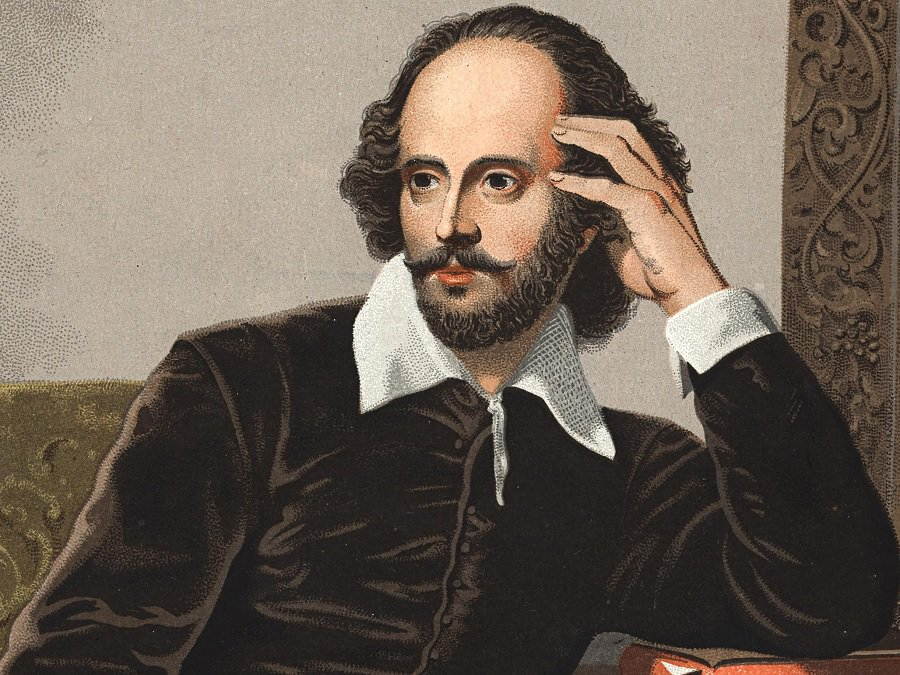
Although no one really knows when Shakespeare's birthday is, it's celebrated this week on April 23rd. Recent scholarship on the bard has presented pretty convincing evidence that he was a recusant Catholic, i.e., refusing to participate in the state religion established by Elizabeth and paying for it through fines and other measures.
Henry VIII wasn't nearly as bold as Elizabeth, his illegitimate daughter by Anne Boleyn. He only made himself head of the Church. She authorized the complete destruction of the Mass including draconian persecution to force the English people to accept the bastardized version. The Shakespeare family (sometimes spelled Shakspere or Shackspeare) resisted. There is significant evidence that Shakespeare's father, John, and his mother were recusants their entire lives. William's daughter Susanna was also a recusant and it was to Susanna that he left his London property that was a house filled with priests holes and used for illegal Masses. A few years after Shakespeare's death a support beam in the house collapsed during Mass and about 90 people out of a congregation of some 300 were killed.
I'm reading Joseph Pierce's book,
The Quest for Shakespeare, which is loaded with evidence that the Bard of Avon was faithful to Rome throughout his entire life. Pierce quotes a summary of evidence from scholar Hugh Ross Williamson that points to Shakespeare's Catholicism.
There are in [Shakespeare's] life, some certainties, some probabilities and some possibilities. It is certain that both his parents were open Catholics who suffered on account of their faith, so that the probability is that...he was brought up as any other cild would be in a devout Catholic home. If he went to school at five, it is certain that his first schoolmaster was a Catholic. It is also certain that from the age of seven to eleven he was taught by a Catholic who eventually became a priest and that among his schoolfellows was one who became both priest and martyr. If he remained at school till he was fifteen, his last master was a Catholic, whose younger brother was also a martyr. It is certain that he was married by a Catholic priest.
It is certain that, by reason of the Shakespeares' relationship with the great Catholic "cousinage" in the Midlands...he was affected by the Somerville plot and possibly on account of it left Stratford. It is certain that the object of his literary attack, Sir Thomas Lucy, was the chief persecutor of Catholics in Stratford. It is possible that Lucy ordered his imprisonment.
It is certain that his patron, Southampton, was a Catholic. It is probable that the martyr and poet, Robert Southwell, dedicated a volume of his religious poems to Shakespeare and it is possible that this influenced The Rape of Lucrece.
In London we have no record, from the parish "token" books, that Shakespeare ever attended an Anglican service, though the signatures of his friends and associates are there. On the other hand, we know that at some period he went to lodge in a family diplomatically immune from the penalties of non-attendance at church. We have no record, among his poems, of any mourning poem for Elizabeth I or praise of James I, such as his contemporaries profusely indulged in; this may be because no Catholics was likely to celebrate a persecuting monarch. His plays, however they are regarded, afford evidence of his understanding of Catholicism and, when considered carefully in their setting, suggest sympathy with it. It is possible that he owned a copy of Hall's Chronicle which he annotated in the Catholic sense: in any case, his bias in the historical plays is Catholic. It is certain that he was said to have "died a Papist" by an early writer and he was mentioned for his Papistry by Speed [John Speed, Protestant historian] during his own lifetime. We know that he bought, towards the end of his life, a notorious center of Catholic activity in London and installed in it a known and practising Catholic, who also witnessed his will.
What does all this amount to? Obviously there is not the same kind of "proof" that Shakespeare was a Catholic as there is that Cardinal Newman was a Catholic. But there is sufficient evidence on which to base a verdict.I confess to being a Shakespeare fanatic. I've read the theories that the plays were written by Christoper Marlowe, Ben Johnson, Edward deVere, Roger Bacon -- but I'm convinced that Shakespeare was Shakespeare. My next book is going to be Clare Asquith's,
Shadowplay: The Hidden Beliefs and Coded Politics of William Shakespeare. If you like who-dunnits, this real-life mystery story is riveting.