

Showing posts with label St. Augustine. Show all posts
Showing posts with label St. Augustine. Show all posts
Saturday, July 25, 2026
Back From Retreat and I'm Exhausted!

Thursday, February 20, 2025
Thought for the day: What a difference one letter makes!

Reading The Imitation of Christ this morning, I came across this:
My God and my all! What more can I have and what more can I desire than You? O sweet and delightful Word! Sweet to him who loves the Word and not the world, nor those things that are in the world.
Sunday, October 27, 2024
Sunday Meditation: When God Doesn't Seem to be Answering Prayers....
....THINK AGAIN!
 |
| St. Augustine & St. Monica, pray for us. |
God always answers our prayers. Sometimes He says yes and sometimes He says no. God loves us so we can be sure when He says no that what we are asking for is not good for us.
When He says yes, sometimes He takes His own time. Abraham and Sarah prayed for a child. God told them, yes, not only would they have a child, but their descendants would be like the stars of the sky. But God made them wait...and wait...and wait.
Instead of trusting Him, they decided to take things into their own hands. Sarah convinced Abraham to have relations with her maid, Hagar. Ai yi yi! We all know how that ended and we're still suffering from the battle between Isaac and Ishmael today.
Maybe God delays fulfillment of His yes to help us grow in patience and perseverance. And sometimes, He rewards that patience and perseverance with an abundance we can hardly imagine. Let me share an excerpt from Trustful Surrender to Divine Providence about St. Monica and her sixteen-year prayer vigil for the conversion of her son, Augustine:
Friday, September 27, 2024
Be Patient with Others, but First with Yourself!
This post continues my reflection on the virtue of patience which I've discussed here, here, and here. It may take me a long time to plumb the depths of this difficult virtue.
I was reminded of patience in a recent conversation with a soccer coach I know. He described one of his young players as being very hard on himself. Whenever the lad makes a mistake on the field he berates himself with self condemning statements. I don't know exactly what he says, but I can imagine, since many of us are also quick to condemn ourselves for our mistakes. Can you hear the refrain in your head?
Friday, July 26, 2024
Love Life, Yes! But this Facebook Meme is Way Off.

Yesterday I posted a Facebook meme with a quote from a saint. Today, I read a meme that means well, but is skewed and wrong. I'm not addressing, of course, the protection of innocent life. We may never murder an innocent baby. But the rest of the meme is head-shakingly wrong.
Thursday, May 16, 2024
It's a Spiritual Work of Mercy: Pray for the Living and the Dead.
I got a message this morning from a dear friend whom I've known since she was a teenager. I did a reading at her wedding back in the early 80s. She asked for prayers for her daughter, a busy mom of many, who is in the hospital with pneumonia. I've received many prayer requests lately: from a young father who's very sick, from an internet friend who lost his job and is near retirement age with not even a thin parachute for his golden years, from a number of sick family members including my sister in a nursing home, and from a number of other suffering souls. I've been keeping the Poor Clares busy with all the requests for their intercessory prayers.
Sunday, March 10, 2024
Sunday Meditation: The Nature of Love

I recently read an article about courtly love in the Middle Ages that began, "Love is the universal feeling." (my emphasis) Is that an accurate statement? If it is, then -- can one also say that "hate" is a universal feeling...or anger...or the desire for vengeance?
Sunday, February 18, 2024

Monday, June 14, 2021
Guest Post: Biden Sacrilege and St. Augustine
By James M. Thunder
This week, at their semi-annual meeting, the bishops of the United States will discuss “Eucharistic coherence,” the issue of how they should react to public figures (Biden, Pelosi and so many others) who promote public policies – in the form of orders, laws, regulations, treaties, budgets, etc.-- contrary to fundamental moral teachings (plural) of the Catholic Church.Their discussion will occur over the objections (“concerns”) expressed in letters dated May 7 from Cardinal Luis Ladaria, prefect of the Vatican's Congregation for the Doctrine of the Faith, and May 13 by 68 U.S. bishops, to Archbishop José Gomez of Los Angeles, president of the U.S. Conference of Catholic Bishops (USCCB).
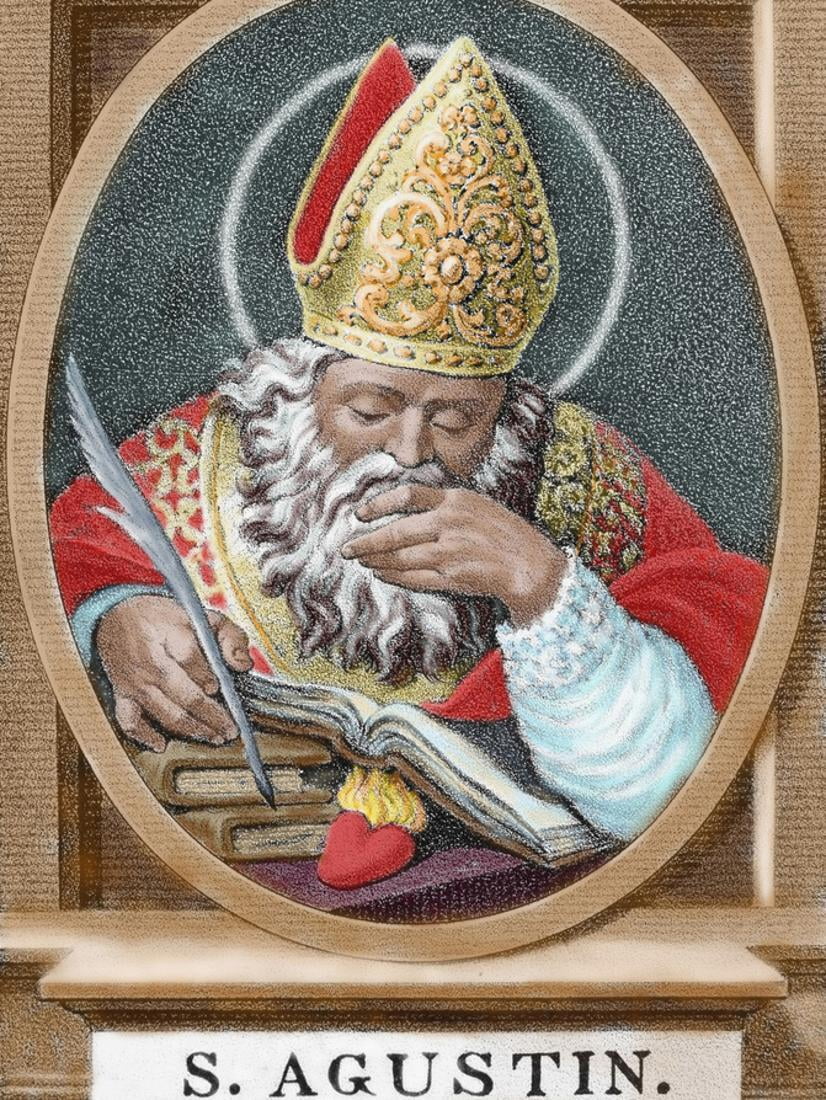 |
| Our hearts are restless until they rest in Thee. |
This week, at their semi-annual meeting, the bishops of the United States will discuss “Eucharistic coherence,” the issue of how they should react to public figures (Biden, Pelosi and so many others) who promote public policies – in the form of orders, laws, regulations, treaties, budgets, etc.-- contrary to fundamental moral teachings (plural) of the Catholic Church.Their discussion will occur over the objections (“concerns”) expressed in letters dated May 7 from Cardinal Luis Ladaria, prefect of the Vatican's Congregation for the Doctrine of the Faith, and May 13 by 68 U.S. bishops, to Archbishop José Gomez of Los Angeles, president of the U.S. Conference of Catholic Bishops (USCCB).
Sunday, May 16, 2021
Sunday Meditation: If You Want to Be Happy for the Rest of Your Life......

O Lord, You made our hearts for Thee,
And ever restless will they be
Until they rest in Thee.
based on St. Augustine
The other day I wrote about happiness and the etymology of the word from Middle English meaning "luck, prosperity, and advantageous circumstances." That association can't hold up. Wealth and happiness are often mutually exclusive. How many rich people do you know or read about whose lives are a mess and families are miserable? Think of Hollywood, a glamorous hellhole filled with prosperous, unhappy people. A long-term marriage is rare, divorce and cohabitation the norm. How many wealthy people seek oblivion in drugs and alcohol. How many are addicted to sex and pornography? How many commit suicide?
Wednesday, August 28, 2019
A Saint for Our Time: Terrorism, Invasion, and Political Upheaval Marked St. Augustine's Life!

Augustine lived in tumultuous times. That's another link to us. Here's what I read at the Columbia College website:
When Augustines' pupil Possidius came to compose a biography of his master (which still survives), he spent little time detailing his master’s ideas; instead, he wanted to highlight for posterity all of the manifold controversies and personal dangers faced by Augustine throughout his life. So we hear, for example, about terrorists called Circumcellions from the so-called Donatist heresy, who launched raids on Catholic churches with a crude tear gas made of lime juice and vinegar, and allegedly laid an ambush to kill Augustine himself. Finally, Augustine lived to see the catastrophic invasion of Africa by the Vandals, and Possidius gives a vivid picture of the struggle to assemble and safeguard his works amidst the general destruction. Possidius’ biography also appends a letter in which Augustine encourages anxious bishops not to flee, so as to provide a ‘place of refuge’ for the displaced. The psychological conflicts depicted in the Confessions are intense, but also largely interior and personal. It is salutary, then, to remember that Augustine was far from detached from the political upheavals that marked the period in which he lived.
Sunday, September 9, 2018
Homosexuality: Behind the Cottage Door
 |
| The unbelievably happy home of two homosexuals |
* Homosexual Heaven
is Really Hell
No teaching of the Magisterium of the Catholic Church is clearer, more pastoral or more logical than that on homosexuality, as presented in the Catechism of the Catholic Church (1997, 2nd Edition). The Catechism makes a firm distinction between homosexual acts and the homosexually oriented persons themselves. It proclaims the eternal truths of Scripture in condemning all such actions, as follows:
- Homosexual acts are acts of grave depravity.
- Homosexual acts are objectively disordered.
- Homosexual acts are contrary to the natural law because they close the sexual act to the gift of life and do not proceed from a genuine effective and sexual complementarity.
- Under no circumstances can homosexual acts be approved.
Sunday, April 2, 2017
Sunday Meditation: Jesus wept over Lazarus to call us to repentance
 |
| "Lazarus, come out!" Painting by Duccio di Buoninsegna |
Tuesday, February 28, 2017
Guest Post: The Warnings In St. Augustine’s City Of God Are Relevant To America Today - Part II
 By Gary Morella
This is Augustine’s own account, in the Retractationes, of the writing of the City of God.
Meanwhile Rome was overthrown by a raid of Goths, led by King Alaric, a most destructive invasion. The polytheistic worshippers of false gods, whom we commonly call pagans, endeavored to bring this overthrow home to the Christian religion, and began to blaspheme the true God with unusual sharpness and bitterness. This set me on fire with zeal for the house of God, and I commenced to write the books Of the City of God against their blasphemies or errors. This work occupied me for a number of years, owing to numerous interruptions of businesses that would not brook delay and had a prior claim on me. At last this large work Of the City of God was brought to a conclusion in twenty-two books. The first five of them are a refutation of their position who maintain that the worship of many gods, according to the custom of paganism, is essential to the prosperity of human society, and that the prohibition of it is the source and origin of calamities such as the fall of Rome. The next five books are against those who, while allowing that such calamities are never wanting, and never will be wanting, to the page of mortal history, and are now great, now small, under varying conditions of place, time, and person, yet argue that polytheistic worship, and sacrifice to many gods, is profitable for the life that follows after death. These first ten books, then, are a refutation of these two vain opinions adverse to the Christian religion. But not to expose ourselves to the reproach of merely having refuted the other side, establishing our own position is the object of the second part of this work, which comprises twelve books; though, to be sure, in the former ten, where needful, we vindicate our own, and in the latter twelve we confute the opposite party. Of the twelve following books, four contain the origin of the two cities, the one of God, the other of this world. The next four contain the course of their history; the third and last four their several due ends. Thus, the whole twenty–two books, though written of two cities, yet take their title from the better of the two, and are entitled by preference Of the City of God.
Monday, February 27, 2017
Guest Post: The Warnings In St. Augustine’s City Of God Are Relevant To America Today - Part I
 |
| St. Augustine of Hippo |
By Gary L. Morella
By common consent St. Augustine is one of the giants of the Latin Church. His life is an inspiration to all those in danger of succumbing to the grave sin of despair because his example is one of going from despair, the work of the devil, to ecstasy, the work of the God. Nowhere is this transformation better manifested than in his monumental work, the City of God, wherein he contrasts the struggle for our souls being waged by the forces of Perfect Good, God Almighty, against the forces of consummate evil, in particular, the “evil one.”
Greek philosophy as it spread out influenced the early generations of Christians. In fact, Plato was the dominant philosophical figure for much of the Middle Ages. Augustine was a Christian Platonist. He was enamored with Plato to the extent that he recognized that Plato arrived at some Christian truths unaided by grace or revelation. St. Thomas Aquinas had this to say about Augustine as a Platonist.
Monday, March 9, 2015
Sunday Meditation: Take Refuge in Church

Augustine isn't too happy about it and here's what he says:
Contrary to the custom of war, these bloodthirsty barbarians spared them, and spared them for Christ's sake...in those places specially dedicated to Christ's name,and of which the very largest were selected as sanctuaries,...Therefore, ought they to give God thanks, and with sincere confession flee for refuge to His name, that so they may escape the punishment of eternal fire -- they who with lying lips took upon them this name, that they might escape the punishment of present destruction. For of those whom you see insolently and shamelessly insulting the servants of Christ, there are numbers who would not have escaped that destruction and slaughter had they not pretended that they themselves were Christ's servants. Yet now, in ungrateful pride and most impious madness, and at the risk of being punished in everlasting darkness, they perversely oppose that name under which they fraudulently protected themselves for the sake of enjoying the light of this brief life.Gosh things haven't changed much since the fourth century. People will take all the gifts God gives them and then blame Him when things go wrong. Some things never seem to change.
I'm saying thank you to God today for every breath I take, every mouthful I eat, every thread on my back, and every person in my life who brings me joy (and even those who don't). And the next time you need refuge from the barbarians in our society, go to Church. "O God, you are my refuge and my strength."
Thursday, August 28, 2014
Thoughts for the Day from St. Augustine
.jpg)
I think every Catholic must be familiar with St. Augustine's statement (which I put in poem form to remember):
O Lord, you made our hearts for theeBut there's another saying that makes me reflect frequently on my life and what I'm doing:
And ever restless will they be
Until they rest in thee.
It is better to do great good among few than little good among many.Toward the end of his life, St. Thomas Aquinas put down his pen calling all his brilliant writings "straw." Well, my writing doesn't add up to a pile of cow pies. And my grandkids are the treasures of my life, each a pearl of great price. With several home schooling families who would happily enjoy some assistance from Gramma, I wonder if putting down my pen and putting on my apron is a better use of my time.
Prayers for discernment would be most welcome.
Wednesday, April 10, 2013
Reenactment Finds St. Augustine Padre in New Role...
...as Ponce de Leon to celebrate the 500th anniversary of Spain exploring Florida! And doesn't the priest playing Ponce de Leon look like Jim Caviezel? As my Florida friend wrote when she sent the video, "Here is our beautiful orthodox pastor last weekend in St. Augustine." Oh blessed St. Augustinians!
Sunday, October 28, 2012
Restless Heart is a great film!
See it on the big screen if you get a chance. The actress playing Monica was terrific as was the actor playing St. Ambrose. Now I want to re-read the Confessions.
Augustine is a saint for our time, a time when so many no longer believe in truth, a time where pride and arrogance rule. Augustine lived a hedonistic life before his conversion, striving for worldly acclaim and human respect. But God was after him and his mother never stopped praying and sacrificing for his salvation. This movie shows how a great sinner can become a great saint. It shows some of the famous scenes in the Confessions like stealing the pears and hearing the voice saying open and read.
Only one caveat, there is a short unnecessarily explicit love scene with open mouth kissing. Now, why did they have to do it? They could have suggested it more subtly. Or is our culture so inured to this that nobody thought anything of it? Sad.
Augustine is a saint for our time, a time when so many no longer believe in truth, a time where pride and arrogance rule. Augustine lived a hedonistic life before his conversion, striving for worldly acclaim and human respect. But God was after him and his mother never stopped praying and sacrificing for his salvation. This movie shows how a great sinner can become a great saint. It shows some of the famous scenes in the Confessions like stealing the pears and hearing the voice saying open and read.
Only one caveat, there is a short unnecessarily explicit love scene with open mouth kissing. Now, why did they have to do it? They could have suggested it more subtly. Or is our culture so inured to this that nobody thought anything of it? Sad.
Monday, December 8, 2008
Immaculate Mary, Your Praises We Sing
 December 8, Feast of the Immaculate Conception
As we get ready for Christmas the Church gives us a beautiful reminder that God Himself prepared in the days before He sent His Son. He gifted the Blessed Mother with her Immaculate Conception, saving her from the effects of original sin at the very moment she was conceived in the womb of her mother, Ann. That preparation is a reminder to us. God didn't start out by choosing apostles, teaching them, and sending them out to the world. No, He began at the very beginning preparing the hearts and minds of the Virgin Mary and St. Joseph. St. Joseph himself revealed to Blessed Catherine Emmerich that he was saved from original sin immediately after his conception. So God prepared a holy home for His Son before Jesus was conceived in Mary's womb.
I think the message for Christians is that we need to be saved personally before we can evangelize others. How can we help to "remove the beam of sin" from the eyes of others, if we haven't repented of our own sins and sought God's forgiveness, especially in the Sacrament of Confession. How many of us are out saving the world while we ignore evil and faults in our own lives?
We are called to be witnesses to the world, but our witness begins with giving an example of repentance. In Advent especially we should listen to the call of St. John the Baptist, "Reform your lives." We cannot hear the good news if our own ears are ringing with the world's noise. We can't hear the angels' hosannas while we listen to the siren song of the evil one. We can't help others to see the truth if our own eyes are filled with images of heterosexual lust from the catalogues of Victoria's Secret and homosexual lust from the catalogues of Abercrombie and Fitch. In today's world protecting our eyes is more important than ever because evil is mainstreamed in mall windows, grocery store magazine racks, and on the Internet.
We need to pray constantly for protection and conversion. A good model for us is St. Augustine whose mother, St. Monica, pursued him literally and in prayer until he finally succumbed to the Hound of Heaven.
Pray the conversion prayer of St. Augustine today to prepare yourself to be a soldier in the army of Christ.
Subscribe to:
Posts (Atom)